Tulsi Kanthi Mala: Meaning, Care & Daily Wear
AI Overview & Key Takeaways
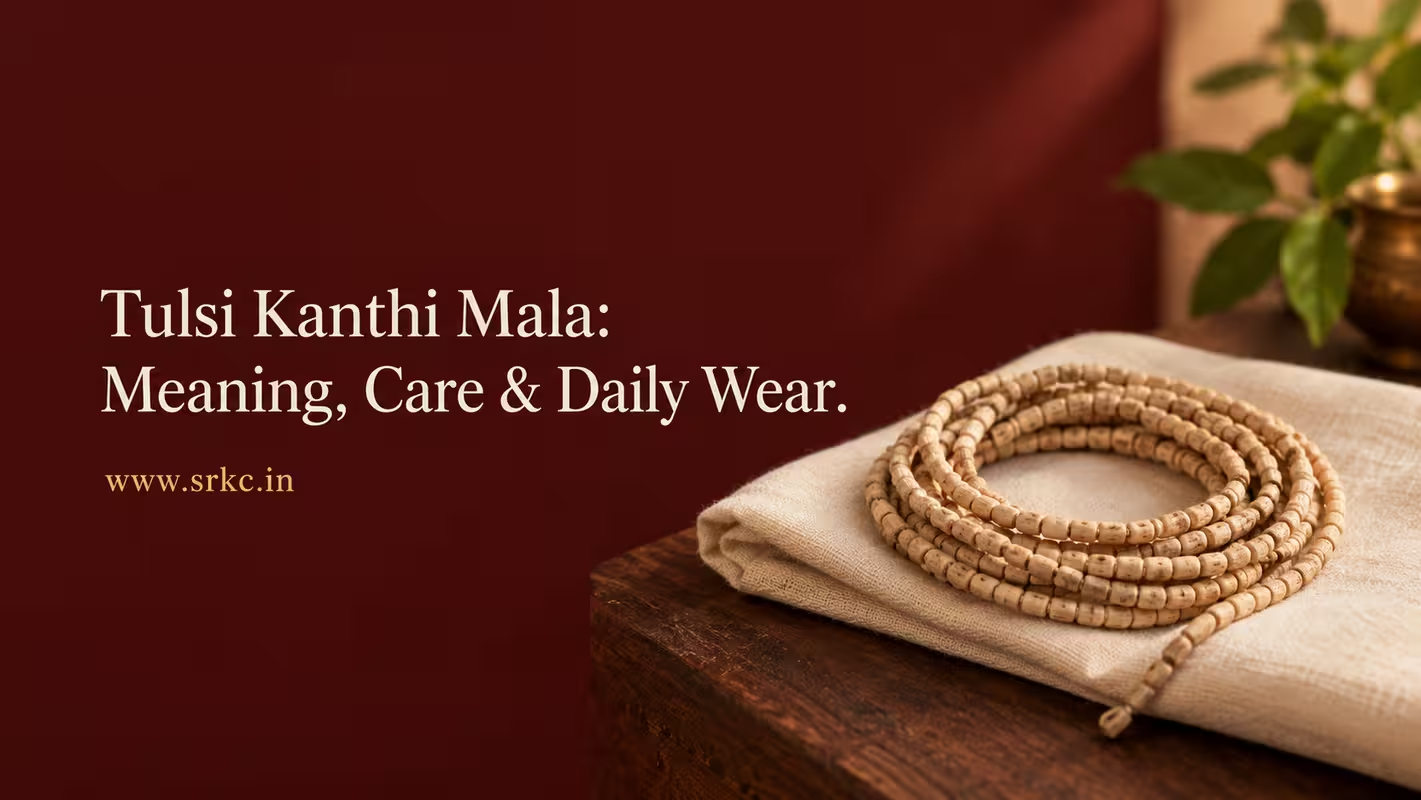
A tulsi kanthi mala (also spelled kanthee) is tulsi wood worn around the neck. It is not the same article as a tulsi japa mala, which is held in the hand for naam jap. Tulsi is called Vrinda. Vrindavan means her forest, and in Braj, bhoga offered to Shri Krishna is treated as incomplete without her leaf. Tulsi remains pure. A broken thread, a fallen bead, or an ordinary change in the wearer’s day does not make her ashuddh. The beads still deserve respectful handling. A kanthi is worn in one, two, or three rounds, and in custom lengths. Strand count is fit and custom, not a rank of devotion. Daily care is simple: keep soap and soaking off the wood, wipe it dry, keep it off the floor, and re-string it if the thread gives way.
A tulsi kanthi mala raises the same few questions. What is it for, how many rounds belong at the neck, is it the same as a japa mala, and what does it mean when the thread snaps?
Kanthi means the throat. This mala is made to be worn there — one round, two, or three, sometimes a custom length, sometimes with a small locket. It is tulsi wood, from the plant also called Vrinda, strung so that remembrance stays against the skin through an ordinary day. It can be made with care. It is not jewellery first. It is dharan: something accepted onto the body.
Vrinda, the forest in the name, and the leaf on the plate
Tulsi has two lives, and both are real.
She is an aushadhi. Ayurveda counts tulsi — holy basil, Ocimum tenuiflorum — among its medicinal plants. That use belongs to the living leaf, not to a wooden necklace. A kanthi is not a dose. It is the same plant’s wood, worn in remembrance.
She is also, for the devotee, someone dear to Shri Krishna. The Padma Purana and the Brahmavaivarta Purana remember her as Vrinda, the devotee worshipped as the plant closest to Vishnu. She is called Keshava-priya — always dear to him. Vaishnava teaching, drawing on the Skanda Purana, speaks of her as auspicious to see, to touch, and to remember. In the Gaudiya line she is addressed as Tulasi Maharani, and the neck beads are one way of keeping that remembrance close. That is a tradition’s language, not a rule every home must repeat in the same words.
The name of the land follows her. Vrindavan is Vrinda-van: the forest of Vrinda. In the Puranic telling this is her van, the ground of Shri Krishna’s pastimes. That is the traditional meaning of the name, not a modern crop survey. In Braj she is not a side plant. She is in the name of the place.
That is why her leaf sits on bhoga. In Braj temples, and in homes that keep the same practice, food offered to Shri Krishna is not treated as complete without tulsi. A line repeated in Vaishnava teaching says that even a full table — the chhappan bhog — is not accepted if her leaf is missing. The leaf is for Krishna and other forms of Vishnu. It is not placed, in the same way, on every deity’s plate. For Shri Krishna in Braj, it is treated as compulsory.
She does not become impure
A familiar fear says that tulsi becomes ashuddh: if the mala breaks, if a bead falls, if the wearer has eaten onion or garlic, if a woman’s monthly cycle has begun. The fear is common. It does not match the way the Puranas speak of her.
The Puranas describe her as purifying in every part — leaf, flower, fruit, root, branch, bark, stem, and even the clay at her root. She is not spoken of as something that loses purity because a day was ordinary, and her leaf is not treated as going stale the way another flower can.
A kanthi does not become impure because a thread wore out, or because the body did what bodies do. A household may still keep its own maryada about the altar or about pausing a particular seva. That is a discipline of the person. Follow it if it is yours, or if your guru has given it. It is not a change in Tulasi.
If the kanthi breaks, nothing inauspicious has happened. Cotton thins. A snag at the collar is wear, not an omen. Gather the beads. Do not leave them on the floor, and do not drop them into household waste. Have them re-strung or, if they can no longer be worn, place them in clean water or at the foot of a living tulsi plant. That handling is respect. It is not a cleaning of something that has turned dirty.
Neck kanthi and japa mala are not the same thing
The names overlap, and the overlap is what confuses a shop.
A tulsi kanthi is for the neck. The count is not fixed at 108. It is worn in one round, two, or three, close to the throat, through the day. People also call it a tulsi mala. That is true of the wood, and confusing about the job.
A tulsi japa mala is for naam jap. It is commonly 108 beads plus one meru, the bead that marks the turn, held in the hand. It is not meant to be worn as a necklace, and a neck kanthi is not meant to be used as a counter. Both may be tulsi. They are not the same article. Many people keep both, and they should.
On SRKC’s mala shelf the two jobs are already separate. A two-round tulsi chandan kanthi and a one-round tulsi kanthi with a Radha Krishna locket are neck strands, listed as handwoven in Vrindavan and sourced from Braj artisans. Beside them sit 108+1 tulsi japa malas, for the Names. A locket, or a few chandan beads among the tulsi, is a finish. It does not make one strand more tulsi than another.
One round, two rounds, three — and what the numbers do not mean
A kanthi is made in one round, two, or three, and it is also made to a custom length, bead, or locket. People ask what two rounds “mean,” and what three mean, as if the number were a rank. There is no scriptural scale that grades devotion this way. One round is already complete. Two rounds are what many devotees wear, including a familiar Gaudiya and ISKCON custom of fine strands at the neck. Three sit fuller. A custom length is simply made for a person. More rounds do not make the wearer purer, and fewer do not make the mala less tulsi.
Choose by fit, by a guru’s instruction if you have one, and by what you can wear every day without it catching. The two-round chandan kanthi and the one-round locket kanthi are two current forms of that choice, not two levels of devotion.
What daily wear actually asks
People who wear a tulsi kanthi often say the mind settles. The strand at the throat is smarana — remembrance that does not wait for the altar. The hand finds it between tasks, in a queue, in a difficult hour. Touch and remembrance of Tulasi are already spoken of as auspicious. A quieter mind is what many wearers report. It is not a treatment, and it should not be offered as one.
Wearing it is uncomplicated.
- Put it on with clean hands, ideally after a bath, with a short remembrance of Tulasi and of Shri Krishna. No long ceremony is required.
- Let it rest at the base of the throat, over or under the collar. It should not cut or catch.
- Men, women, and children in a family may wear it. It is not reserved for one gender or one city. Anyone drawn to it may accept it. A guru’s instruction, where you have one, comes first.
- It is meant for the day, and many people sleep in it. At bath time, take it off or keep soap and shampoo off it. Water with detergent is what cracks soft wood and rots thread. Keeping it dry through a wash is care of the bead, not a purity rule.
- A woman does not have to remove it during her period out of fear that tulsi will be spoiled. If a family pauses certain altar seva on those days, that custom can be kept on its own. The kanthi has not become contaminated.
In many Vaishnava homes, and widely in Braj, accepting tulsi dharan goes together with leaving onion and garlic. The meal stays closer to the sattvic food offered as Krishna’s bhoga. This is the wearer’s niyama, not a stain on the wood, and not a rule every Hindu household keeps in the same form. Where it is yours, or your guru’s, keep it as discipline.
Care that keeps the wood
Tulsi wood is soft. It darkens. It can crack if it is soaked, left in harsh sun, or met with perfume every morning. None of that is a spiritual failure.
- Wipe with a dry, clean cloth. Do not soak the beads, and do not use soap, toothpaste, or polish. If they are splashed, pat them dry and leave them in open air — not on a hot sill, and not under a dryer.
- Keep perfume, deodorant, and hair oil from being sprayed onto the strand.
- If it falls, pick it up. Tulsi is not left on the floor. Re-string the thread when it frays, before it snaps in a crowd. Soft cotton is traditional, and it is the part that wears out first.
- Colour deepens from honey toward brown, sometimes nearly black, from skin, air, and years. A dark bead is still tulsi. Darkness is age, not impurity.
If you are choosing one, look for wood rather than a perfect copy. Real tulsi beads vary a little in tone and surface. They are light, matte, and carry a mild dry fragrance when new. Beads that are glassy, identical to the last line, or scented like perfume are usually not tulsi wood. A brass lock or a locket is a finish. It is not what makes the kanthi real.
Worn this way, a tulsi kanthi stays a small daily thing: Vrinda at the throat, the leaf’s same presence remembered between tasks, the strand kept dry, the beads never thrown away as if they had failed.
Radhe Radhe.
Frequently Asked Questions
Common questions and Vedic insights related to Tulsi Kanthi Mala: Meaning, Care & Daily Wear.
It is a strand of tulsi-wood beads worn around the neck as Vaishnava dharan. Kanthi refers to the throat. It is also spelled tulsi kanthee. People sometimes say “tulsi mala” for the same strand, but that phrase is also used for a japa mala, so the two are worth separating.
Vraddhi Kaushal
Authored and curated under the guidance of traditional sthapatis and artisans at SRKC. Every piece and blog is steeped in Shilpa Shastra, Agama Shastra, and centuries of temple dedication.